FIELD JOURNAL
A STORY THAT TOOK NEARLY A DECADE TO TELL.

THE SHORELINE BECAME THE WORLD
Nearly a decade ago, I started putting together an idea I hoped to pitch to National Geographic. It was about this beach. I never finished it.
There was no shortage of things to photograph. The birds were here, their lives unfolding only a few miles from home. What I could not figure out was how to make the case for them. In my head, this familiar shoreline kept getting compared with mythic snow leopards, legendary mountain gorillas and faraway places people dreamed of putting on a bucket list.
And then there was this beach. A parking lot. Summer crowds. Families carrying coolers across the sand. Tiny birds nesting somewhere in between it all. I found watching them exhilarating. What I could not explain was why any of it should matter to someone simply coming here to enjoy the beach.
Why should the people coming here care?
I could not answer it.
Almost ten years passed. I photographed wildlife professionally, traveled the world and eventually began teaching photography myself. Somewhere along the way, I became less interested in how to make a photograph and more interested in why one mattered.
Yet that unfinished story kept coming back. Having grown just slightly wiser, I found myself thinking again about one of the most familiar places I knew. Maybe familiarity was not the problem. Maybe I had failed to understand what made this place special in the first place.

STORIES WE ALREADY KNOW
The clues were sitting in photographs I had made years earlier.
Some photographs stay with me because they are beautiful. Others stay because I still think about what happened inside them.
Those were the images I kept returning to. Not because of the light or composition, but because there was more happening inside them than a single frame could explain. A small behavior. A relationship. A moment that seemed to keep going long after the shutter.
COME ON, ONE BITE.
One stubborn chick wanted absolutely nothing to do with the fish its parent had brought. The parent offered it once, then again, while the chick continued refusing. At one point, its sibling even seemed to pin it down as the feeding continued.
Watching through the camera, I remember thinking I had seen this tantrum before. Usually there was a spoon, a high chair and a tired parent asking for one more bite. I could not know what the birds were thinking. I only knew the scene felt familiar.
NOT ON OUR TURF
An oystercatcher chick and a tern chick seemed perfectly content beside each other until the adult oystercatcher returned. Almost immediately, the adult showed aggression toward the tern chick.
A moment later, the oystercatcher chick copied the parent. It felt like a small shoreline version of Romeo and Juliet. The kids seemed to have no issue with each other until an older generation reminded them they belonged on different sides.
Watching it felt uncomfortably familiar. Some things are learned long before they are understood.
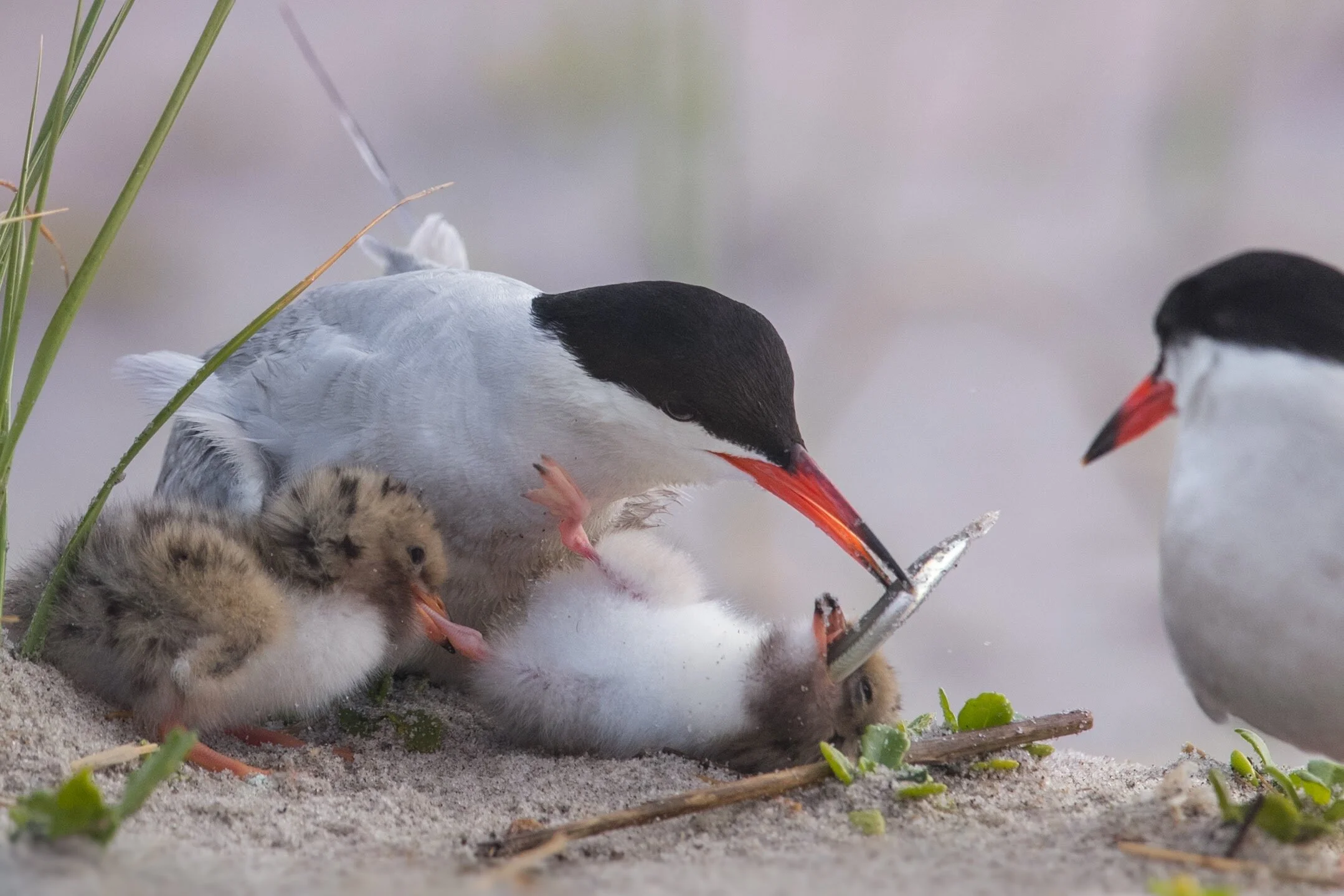
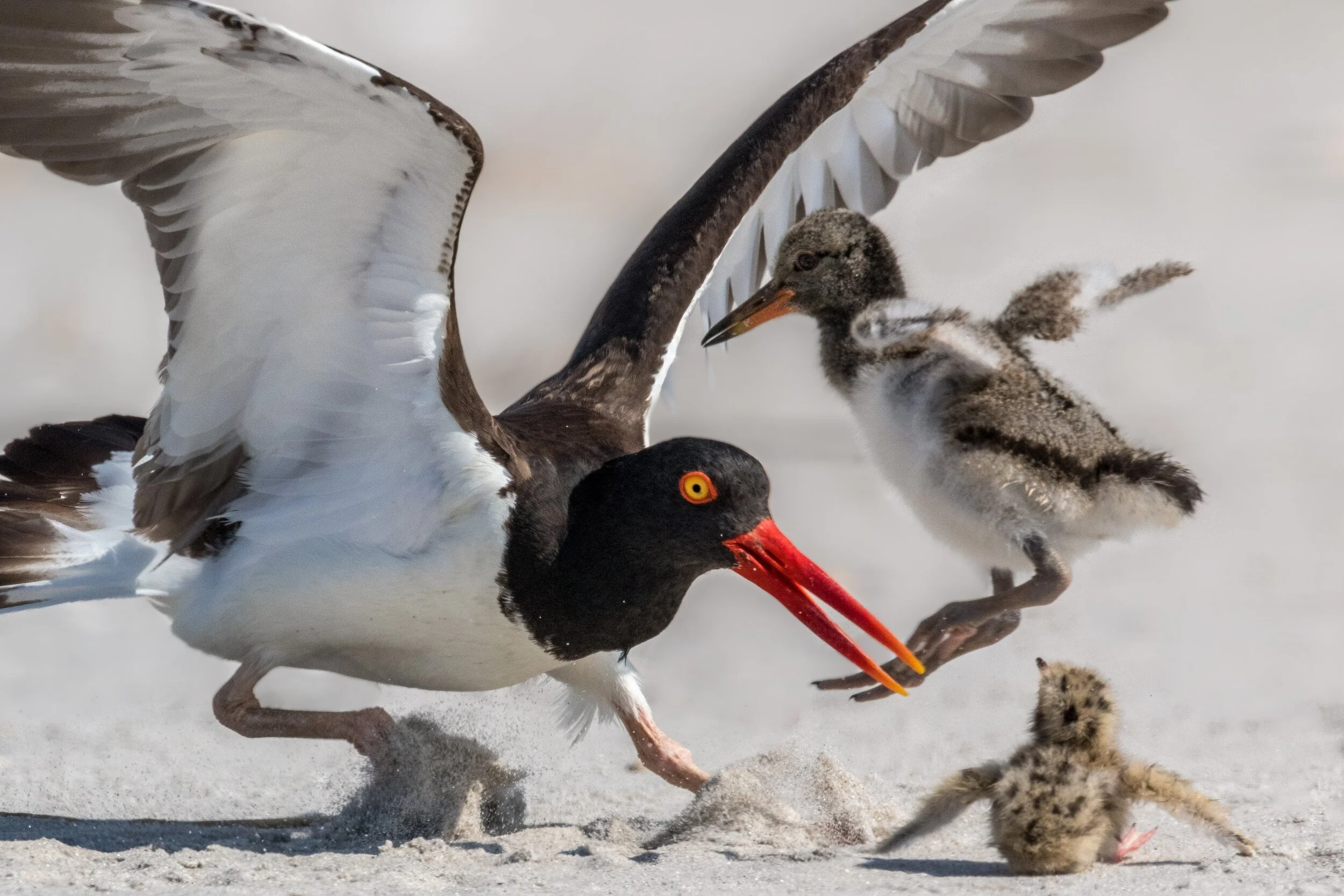
These were not human stories, and I was not trying to make them human. But the longer I watched, the less distant their lives sometimes felt. That mattered because familiarity was exactly what I had once thought made this shoreline difficult to tell as a story. Maybe I had that backward.
For the first time, I wanted to return not just for another photograph, but to see what happened between them.

BEFORE THE WORLD WAS AWAKE
To find these stories, I had to be there when their world was awake and active. That meant very early mornings. I would drive through the dark, walk over the dunes, settle somewhere on the sand and wait for light to reveal the beach around me.
At first, I assumed commitment would be the difficult part. But as with assignments before it, waking earlier, staying longer and, most importantly, returning again and again eventually felt more like a gift than a chore. Put in enough mornings and eventually the moments would come.
They did. The harder part was learning how to be there without changing them.


AT THE EDGE OF THEIR WORLD
Walk directly toward a flock and they will usually tell you how they feel about it. Heads rise, calls change and feeding stops. Keep going and eventually something moves. Usually them.
So I began changing how I entered their space. I arrived while it was still dark, got low and settled against the sand before the beach became active around me. The birds still knew I was there, but I was no longer a tall figure walking directly toward them. Their behavior was noticeably different. A researcher later told me that some of these birds may even recognize individual people.
The clearest example came from the ocean. Partly submerged in the surf, I watched terns dive only three or four feet in front of me. I had not moved toward them.
They had moved toward me.
After that, chasing birds made less and less sense. Follow one and you usually end up photographing an animal trying to leave. Waiting forced me to pay attention to why a bird was moving in the first place. Maybe there was food ahead, a chick nearby or a stretch of waterline it kept trying to reach.
Once I understood the motivation, I stopped following and simply waited. Over time, I noticed smaller things too. Feeding stopped. A call changed. A parent suddenly chose another route. Distance became less about getting closer and more about what the bird was telling me.
What changed because I was here?
That became the more useful question. Even the long lens took on a different purpose. It was not there to help me get closer. It allowed me to stay farther away.
Slowly, the photographs improved. I began seeing behavior I would have missed earlier, and birds sometimes closed the distance on their own terms. For a while, it felt like I was finally beginning to understand how to work this beach.
Understanding the birds was one thing. Controlling the morning was another.

THE BEACH OWED ME NOTHING
Photography teaches you to tidy the world. Wait for beautiful light. Find the clean angle. Lose the background buildings. Keep the crowd outside the frame. Wait until everything lines up.
I had spent years getting better at exactly that. The more mornings I spent here, the more I noticed how rarely life arranged itself into the photograph I wanted. Wind flattened feathers. Wildfire smoke changed the light. Sandal footprints crossed clean sand. People wandered through backgrounds. Trash appeared where I wished it had not.
I kept waiting for the beach to give me the version I had pictured. Golden light. Clean sand. Perfect behavior. No distractions. Then there were mornings when the possibility of that photograph disappeared altogether.
One morning, hail swept across the beach.
The light vanished and people began packing up. Everyone who could leave did. Eventually my camera stopped cooperating too. I remember looking at the conditions and thinking the morning was over, that whatever I had imagined capturing was gone with it.
The birds were still there. We could leave the storm behind. They could not.
It was simply the morning they had been given.
I kept thinking about that afterward. There were photographs from difficult weather that I once would have culled immediately. The light was poor, the feathers were wet or the scene was messy. Now those frames felt different. They were not prettier. They were closer to the conditions these birds actually lived through.
The same thing began happening with footprints, fences, people and trash. I had spent years learning how to make nature look untouched, while this shoreline kept reminding me that untouched was never the story here.
That realization also made me question the film. Many of the nature documentaries I grew up admiring allowed the human world to disappear. Mine kept pulling it back into view. Some mornings there was so much trash scattered across the sand that the idea I had started with felt almost naïve.
What if people simply did not care?
I never found one clean answer. Some mornings were discouraging. On others, someone stopped to ask about a nest, walked around a closure, picked something up or simply stood nearby watching. The more time I spent here, the harder the story became to simplify.
The beach had other ways of reminding me how little control I actually had. I checked a piping plover nest morning after morning, hoping to see the eggs hatch. The morning it finally happened, I was at the other end of the beach.
Weeks of waiting came down to a few minutes I happened to miss. I had prepared and I had been patient, but the beach had never promised me the moment.
Somewhere during those mornings, I stopped measuring every day by what I brought home on the memory cards. Some of the moments I remember most clearly were not the ones that gave me the photographs I expected.
By then, simply watching no longer felt like the end of the story.

WHEN INTERVENTION MATTERS
For months, I had been learning that respecting wildlife often meant backing away. Then I watched researchers catch a bird.
A wild bird was suddenly in hand, measured, banded and released. After spending so much time learning how to respect their space, the contradiction was difficult to miss.
But the researchers were working at a scale I could not see through my camera. A few carefully controlled minutes could allow that same bird to be recognized months or years later, helping reveal where it traveled, whether it returned and which places it depended on along the way.
Scientists dedicate their lives to following those larger patterns, but they cannot be on every beach every day. The daily part belongs to all of us. The volunteer watching a nesting area. The photographer deciding to give space. The family walking around a closure. The person taking home the candy wrapper they brought to the beach.
Scientists can help us understand what populations need and inform decisions that shape the landscape. A beachgoer has a much smaller decision to make, but a more immediate one. What will this bird encounter today?
I had started this project asking why people should care. By then, the question felt incomplete.
What do we do once we notice?

RETURN 70
Same path. Same dunes. Same ocean somewhere beyond the dark.
After seventy returns this year, the path was familiar, but the way I saw the beach had changed. I knew some of the calls now. I recognized families. I knew where certain birds tended to appear and when something about the shoreline felt different. Mostly, I knew enough to understand how much remained beyond me.
Nearly ten years earlier, I thought this shoreline had to feel extraordinary, the kind of place someone might put on a bucket list, before anyone would care about it. After seventy mornings here, that idea seemed almost backward.
Its familiarity was the point.
We come here too. We bring our families, repeat the same summer rituals and return to the same stretches of sand until pieces of our lives become attached to them. Year after year, the birds find their way back here too.
I had once imagined that caring for them would come at some great cost to everyone else using the beach. What surprised me was how little most of it actually asked of us. A few extra feet of distance. Something carried home instead of left behind. A protected area walked around rather than through. A moment spent noticing that another life was already here.
None of that asks us to love the beach less. Maybe sharing it simply asks us to leave enough room for another life to be here too.
I will remember the storms, the photographs I made and the ones I missed. The mornings when almost nothing happened. The families I watched change through the season.
And next year, when the birds begin returning, I know I will wonder who made it back. Eventually, I will come looking.
Not because the film needs another photograph.
Because I do.